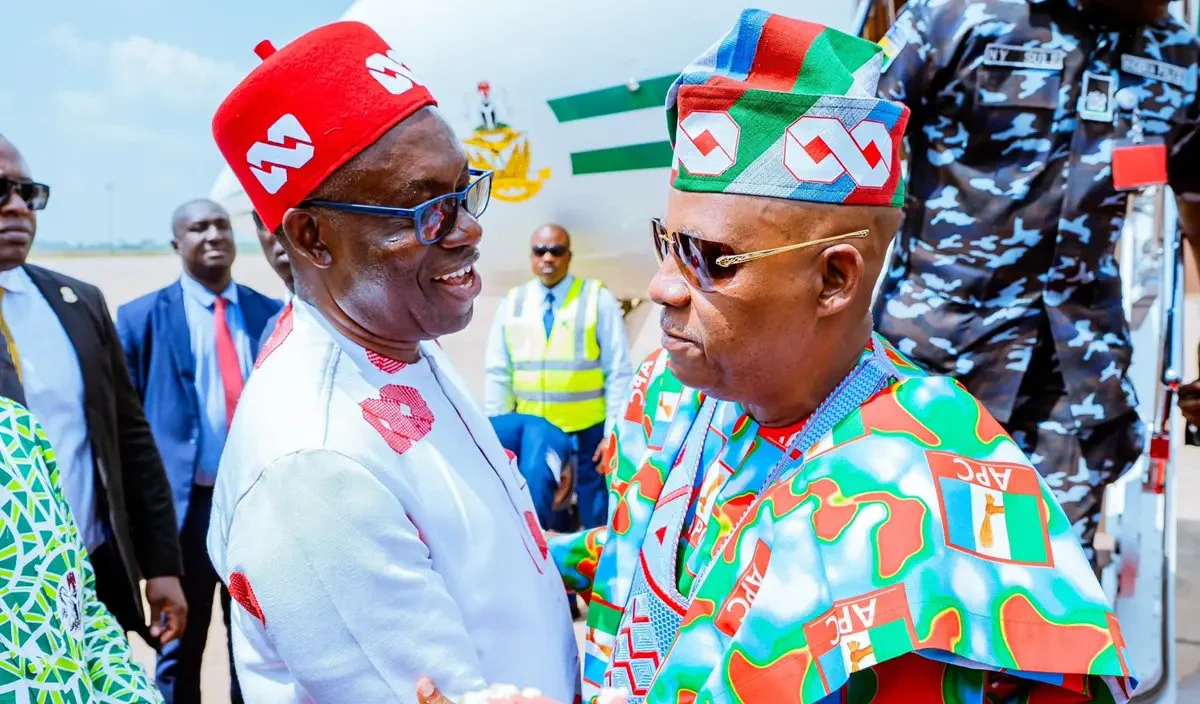

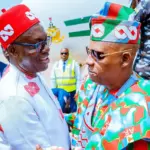
Vice-President Kashim Shettima has declared that the South-east will produce Nigeria’s president when power next returns to the South after President Bola Tinubu’s two terms in office.
Shettima made the declaration on Thursday at the All Progressives Congress (APC) presidential campaign rally in Awka, Anambra State, where he urged the Igbo to embrace national unity and strengthen political alliances with other parts of the country.
“And in the next dispensation when power comes to the south, I can assure [you] that power will find its residence in the eastern region,” Shettima said.
He appealed to the Igbo not to allow political disagreements and ethnic sentiments to undermine their relationships with other Nigerians, stressing the need for greater cooperation across regional boundaries.
The vice-president described Tinubu as a friend of the Igbo, citing his family’s connection with the South-east as evidence of the president’s disposition towards the region.
“President Tinubu is a friend of Ndigbo. His son, Seyi, is married to a lady of Igbo extraction. If he hates Igbo, he couldn’t have allowed his son to marry an Igbo lady. So we are essentially one people,” he said.
Shettima noted that the Igbo had a substantial presence outside their geopolitical zone, claiming that about 17 million lived in northern Nigeria, while another 10 million resided in Lagos.
He urged them to utilise their connections across the country to build political bridges, arguing that electoral victories could not be secured solely through support from a candidate’s traditional political base.
Citing former President Muhammadu Buhari’s political journey, Shettima said the former president’s repeated failures to win the presidency demonstrated the importance of reaching out to other regions.
He recalled that Buhari lost the presidential elections in 2003, 2007 and 2011 despite having a strong following in northern Nigeria.
“Peter Obi cannot be more popular than Muhammadu Buhari. When Muhammadu Buhari tried to become the president of Nigeria in 2003, he was unable to cross the rubicon. He tried it again in 2007; he lost. He had a captive 15 million voters in northern Nigeria. He tried it again in 2011 and lost,” Shettima said.
“It was by having a handshake across the Niger that he was able to win the presidential election in 2015.”
The vice-president urged the Igbo to make informed political choices that would promote national development, rather than allow ethnic considerations to shape their political relationships.
He also disclosed that some of his closest friends and political associates were from the South-east, adding that his relationships with some governors in the region were stronger than those he maintained with governors from the North.
“That shows that what binds us together supersedes whatever that divides us. We are eager to come along with Ndigbo,” he said.
POWER ROTATION
Shettima’s declaration comes amid Nigeria’s informal power rotation arrangement, which has traditionally seen the presidency alternate between the North and South.
The North produced former President Muhammadu Buhari, who governed from 2015 to 2023, before power shifted to the South following Tinubu’s election in 2023.
Tinubu’s first term ends in May 2027. If re-elected, his second term would end in 2031, completing eight years of southern leadership.
Under the informal arrangement, the North would be expected to produce the president for the subsequent eight-year period, potentially paving the way for power to return to the South in 2039.
This could create another opportunity for the South-east to pursue its ambition of producing Nigeria’s president.
However, the Nigerian Constitution does not provide for power rotation. The application of zoning in future presidential elections will depend on decisions by political parties and regional stakeholders.
Shettima: South-east will produce president when power returns to the south in 2039