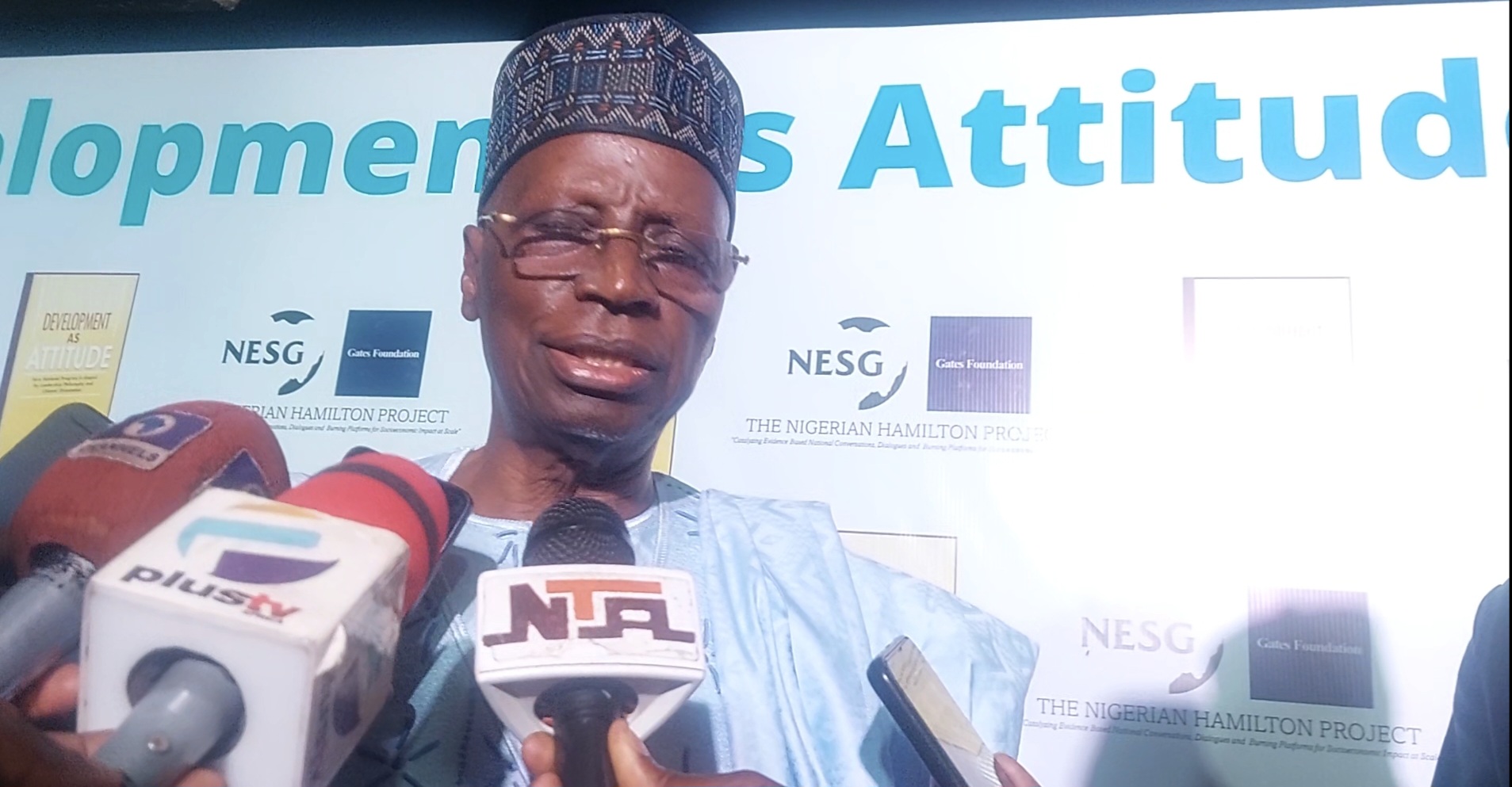
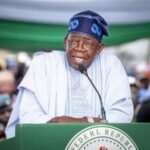
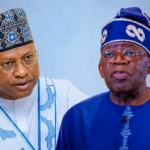


A former finance minister, Dr. Shamsuddeen Usman has said that the social contract between the Nigerian state and its citizens has broken down, leaving development efforts stranded.
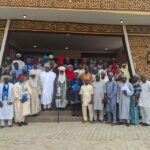
Usman stated this on Thursday night at national dialogue on development attitude organised by the Nigerian Economic Summit Group (NESG) on Thursday night at Arewa House, Kaduna.
The dialogue, held under the NESG’s Nigerian Hamilton Project, brought together thought leaders, academics, and policy experts to examine the cultural and attitudinal drivers of development.
The dialogue was anchored on the central thesis of “Development as Attitude”, a book authored by Prof. Osita Ogbu, Co-Chair, NESG National Economic Advisory.
Usman said although Nigeria has enjoyed 26 years of uninterrupted democratic governance, the substance of democracy is missing.
“We have the instruments of democracy at the three tiers of government, three arms of government, electioneering, political parties and so on,” he said.
Usman who was one of the penalists at the occasion, noted that, there is no integrity, no accountability, no citizen participation in the democratic process.
“Citizens have actually been made almost a non-factor as far as our politics is concerned”, he added.
According to him, the absence of accountability and civic inclusion has eroded the basic expectations citizens have of government.
“There is really no social contract in Nigeria as you have it in other climes where the government says, ‘We will take care of your security, education, health’ in return for taxes and your civil behaviour. Unfortunately, we have lost that,” he said.
The former finance minister recalled the high political tension during the transition from President Umaru Musa Yar’Adua to President Goodluck Jonathan, describing it as a period when the country came dangerously close to crisis.
He said, “Many people did not know how close to the precipice the country was at that time.
“There was a split among members of the executive council. We had a political system that rose to the occasion and averted that crisis.”
He said while Nigeria had moments of democratic maturity, the current system is dominated by personal interest.
“Politics is about ‘we’, the politicians. Nobody is thinking about the citizens.
“Nobody cares about the fundamentals of what the state owes the citizens…
He warned that without law and order, economic planning is meaningless.
“There is no law and order in this country today. No accountability, no concern for the citizens. Even how we resolved the Kwam 1, Kwam 2, and Kwam 3 situation was arbitrary.
“What has happened is that many other people will do the same and get away with it.”
Usman also called for electoral reform and political party financing regulations, citing the late President Yar’Adua as an example of a leader who acknowledged flaws in the process that brought him to power.
“We need people that are honest like the late President Yar’Adua, who said this process is faulty and was willing to change it.
“He started that by appointing the Uwais Commission.”
He said it will be difficult to effect reforms because those who benefit from the system are unlikely to change it.
“My first assignment as Minister of Finance, we worked out a simple macroeconomic model and went to the National Assembly.
“At the end of the day, they were only interested in how much was going to their constituency projects,” he said.
In an interview with journalists shortly after the event, Osita Ogbu, co-chair of the NESG National Economic Advisory Council, said development is not just an economic process but a mindset that must be shaped by leadership and public values.
Ogbu said for Nigeria to make progress, it must deliberately reorient its leadership culture.
“You don’t go into office empty handed — without knowledge and understanding of what you want to achieve.
“Our institutions need to intensify the process of leadership development”, he said.
He stressed that leaders must come into office with values, competence and vision.
“The electoral process must throw up people with ideas. And if you don’t have ideas, look for those who do,” he said.
Also contributing another penalist, Dr. Habiba Lawal, former Special Adviser to the President on Policy, said development requires leadership that is visionary and inclusive.
“We need a leader that is fearless, optimistic, ready to transform and manage diversity.
“Nigeria needs visionary leaders with strategic thinking who can build consensus and mobilise citizens to achieve shared goals”, she said.
Earlier in his address, Senator Uba Sani, Kaduna state governor, represented by Lawal Habib
Permanent Secretary, state Ministry of Finance, said the dialogue would inspire new thinking and reinforce the state’s commitment to governance, fiscal responsibility, and inclusive growth.
Usman, ex-finance minister decries failed leadership, says Nigeria’s social contract with citizens has broken down