



By Abdul Mahmud
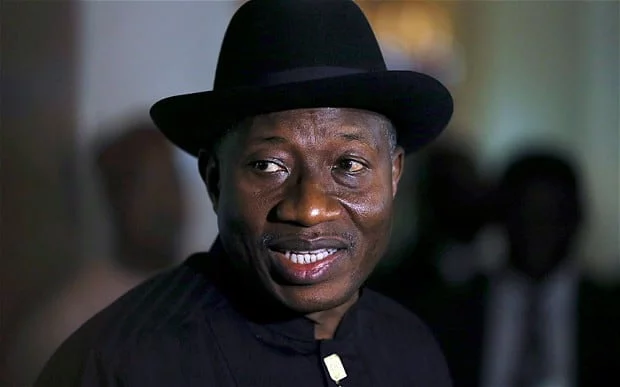
The question of future presidential elections has long been resolved, both politically and legally. Yet, with fresh whispers circulating about his possible acceptance of overtures from political interest groups to run in the 2027 presidential election, that same well-worn question of constitutional eligibility has once again resurfaced.
Curiously, The Vanguard Newspaper, in its report of Thursday, 8 August 2025, has re-entered the fray, probing a matter that had long reached its terminus. In doing so, it draws on the opinions of a few legal practitioners who, regrettably, seem to have offered commentary unmoored from the letter and spirit of the law. One such example is the position taken by Johnmary Jideobi, Esq., whose interpretation rests on a fragile premise. He asserts: “If President Jonathan contests again and eventually wins in 2027, he will have exceeded the maximum number of eight years contemplated by the Constitution for any person to occupy the office of the President of the Federal Republic of Nigeria…
This is the fountain and foundation of the Supreme Court’s jurisprudence explicated in the case of MARWA & Anor v. Nyako & Ors (2012) 6 NWLR (Pt. 1296) 199 wherein the Supreme Court near exhaustively (in a consolidated appeal) dealt with the issue of tenure elongation by some governors. This obviously raises a fundamental question of the eligibility of President Jonathan to put himself forward for an election into the office of the President of the Federal Republic of Nigeria. It appears that the jurisprudential floodlight afforded by the referenced Supreme Court decision points in the direction of his ineligibility”.
But this interpretation, persuasive in its cadence, collapses under the weight of a careful reading. The Marwa v. Nyako decision, while seminal in questions of tenure elongation, does not speak to the peculiar circumstance that surrounds Dr. Jonathan’s case; a circumstance already adjudicated upon and settled.
Indeed, to recycle old anxieties in the absence of new constitutional developments is to ignore the clarity already provided by the courts and to indulge in speculative jurisprudence. Whatever else may be said about 2027, the question of Dr. Jonathan’s eligibility is not a mystery waiting to be solved. It is, quite simply, a matter already resolved, if only we would heed the law.
The controversy surrounding Dr. Jonathan’s constitutional eligibility is thus not novel. To the best of my recollection, the argument that he is disqualified from seeking the presidency was first articulated five years ago by my friend, Dr. Law Mefor, and later echoed by Femi Falana, SAN, three years ago.
I disagreed with their positions then; and I remain unpersuaded today. Clearly, the debate over Dr. Goodluck Jonathan’s constitutional eligibility to seek the presidency under Section 137(3) of the 1999 Constitution (as amended) is one that refuses to rest.
Yet, a close examination of the relevant legal provisions and judicial authorities suggests that the arguments claiming his ineligibility are fundamentally flawed.
What does Section 137(3) actually provide?
Section 137(3) of the Constitution provides:
“A person who was sworn in as President to complete the term for which another person was elected as President shall not be elected to such office for more than a single term”.
This provision, introduced by the constitutional amendment in 2018, has been cited as a bar to Dr. Jonathan’s potential candidacy. However, a proper reading of the law and relevant judicial precedent demonstrates that this provision does not apply retrospectively, and therefore cannot disqualify him.
As a matter of settled legal principle, statutes are presumed to operate prospectively, only in relation to facts or events occurring after their enactment, unless a contrary intention is clearly expressed. Section 137(3) contains no such express or implied intention of retroactivity. It deals with substantive rights, not procedural matters, and thus cannot be applied in a manner that extinguishes rights already vested before its enactment. This principle was firmly restated by the Supreme Court in Ojokolobo v. Alamu (1987) 3 NWLR (Pt. 61) 377, where the Court held:
“It is a cardinal principle of our law that a statute operates prospectively and cannot apply retrospectively unless it is made to do so by clear and express terms, or it only affects purely procedural matters and does not affect the rights of the parties”…
The Court continued:
“It is a fundamental rule of Nigerian law (received from English law) that no statute shall be construed to have a retrospective operation unless such a construction appears very clearly in the terms of the Act or Law; or arises by necessary and distinct implication…
A statute is retrospective which takes away or impairs any vested right acquired under existing laws, or creates a new obligation, or imposes a new duty, or attaches a new disability in respect to transactions or considerations already past”. Per Obaseki, JSC.
Against this background, the argument that Section 137(3) disqualifies Dr. Jonathan is untenable. The provision cannot retroactively extinguish his vested right to seek elective office, a right that predates the 2018 amendment. Regrettably, some legal analysts and commentators have relied on Supreme Court decisions such as Obayemi v. PDP (2019), Gusau v. APC (2019), and Kusamotu v. APC (2019) to support their view of Jonathan’s ineligibility. But those decisions dealt squarely with the computation of time for the filing of pre-election matters; and not with substantive disqualifications under Section 137(3). They offer little, if any, interpretive guidance on the constitutional provision in question.
The correct guide remains Ojokolobo’s case, not the oft-misapplied Marwa v. Nyako (2012) 6 NWLR (Pt. 1296) 199, which has been stretched far beyond its contextual meaning. Marwa dealt with tenure elongation and was based on a factual scenario and legal question wholly different from the issue of retrospective disqualification. To interpret Section 137(3) as applying retroactively would be to introduce absurdity into the Constitution; a result the courts are bound to avoid. The canon of constitutional interpretation demands coherence, not distortion.
Furthermore, on the related issue of whether Dr. Jonathan has already served two terms of four years, and is thus barred from serving a third, clarity is again found in law. Dr. Jonathan served one elected presidential term from 2011 to 2015.
The year he completed following the death of President Umaru Musa Yar’Adua in 2010 does not constitute a term within the meaning of the Constitution. This position was settled by the Court of Appeal in Cyriakus Njoku v. Dr. Jonathan & Ors (2015), where the Court distinguished Dr. Jonathan’s succession from the facts in Marwa. The Court held that his initial assumption of the presidency in 2010 was not by election, but by constitutional operation under Sections 146(1) and 137(1)-(2).
It further found that he had taken only one oath of office as elected President, not two.
Thus, the notion of “two terms” must be strictly tied to elected tenures, not to constitutionally mandated succession arising from vacancy in office.
In conclusion, the right to seek elective office remains a fundamental constitutional right. Whether or not the electorate chooses to return Dr. Jonathan to the presidency is a political decision to be made at the ballot box.
My concern here, however, is not with politics but with the law. Until the courts pronounce otherwise, it is clear that Section 137(3) applies prospectively and does not disqualify Dr. Jonathan from contesting the 2027 presidential election.
No more.
2027: Jonathan constitutionally eligible to run for presidency again