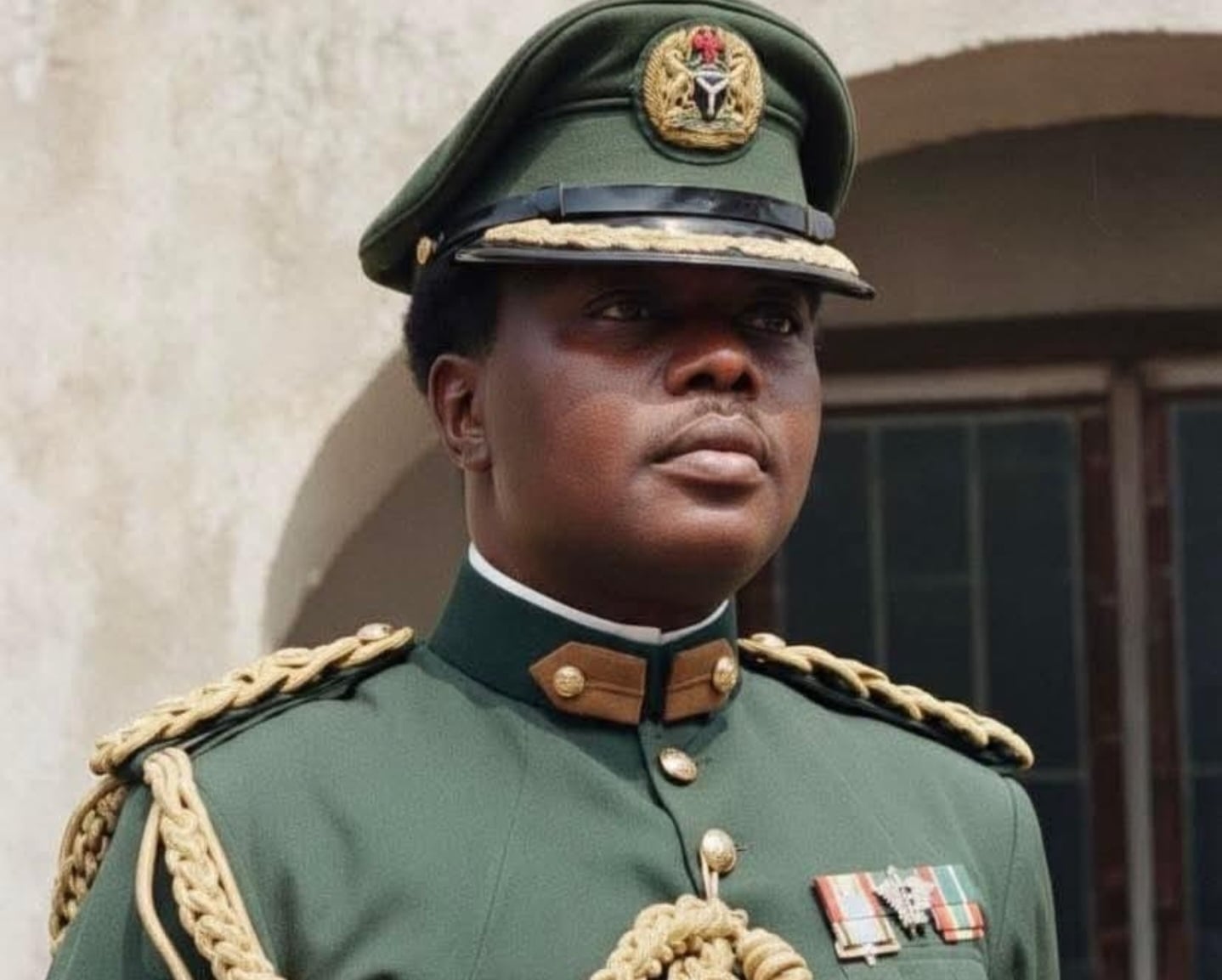





“People are asking why are we not killing terrorists even if they have killed others. Well, even in the Bible, the prodigal son was given a chance, so we should give terrorists a chance to repent if they want to… But even in the Bible, we heard about the prodigal son. If there was not that window for the man to come back, would they have come back?”
– General Olufemi Oluyede, Chief of Defence Staff
Call it a sermon, a parable, or a generous theology of mercy, delivered not from a pulpit; but from the high command of a nation at war with shadows that carry guns and chant death into the night. The prodigal son has returned to kill the fatted calf, and lay out the feast. Let the nation rejoice.
Except the feast is laid with the bodies of its soldiers.
Last night, in Borno State, the 29 Brigade at Beinesheik was overrun. Not harassed. Not probed. Overrun. A full sentence, heavy with consequence. The Commanding Officer, Brigadier General Oseni Omoh Braimah, Edo-born, Nigerian bred, soldier to the last breath, now lies silent. Another star extinguished, bringing the number of senior officers killed in recent time to three. Three. Another uniform folded into grief. Another family consigned to the polite cruelty of presidential condolences. Another confident account emerges from the army high command, assuring Nigerians that the terrorists were repelled and many neutralised. But the images from the Brigade command speak in a harsher tongue. They reveal scorched earth, charred military vehicles, and blackened timber strewn across the grounds, arranged with a grim deliberateness, like wood set in order upon an altar for sacrifice, as in the ancient scriptural scenes where offerings were prepared for the consuming fire.
The prodigal sons are not wasting time. They are on a killing spree.
I am reminded of that ancient Roman, satirist, Juvenal, who would have laughed. Not from amusement, but from that dark well where satire is drawn and absurdity and horror drink from the same cup. What is left to say when a state begins to speak in parables to men who answer only in bullets. Here, poetry redeems the arithmetic of death where generals fall and terrorists are invited to repentance with scriptural tenderness.
Rome, in its decadence, still understood one thing. The enemy at the gate was not a metaphor.
Here, the enemy is at once a theological subject and project.
One imagines the scene in Beinesheik. Terrorists, assault rifles slung across their shoulders, blood not yet dry on their hands, pause to inspect the carnages left behind after heavy firefights. Thoughts pierce through swirling smoke. The chance to return through the window opened by the Chief of Defence Staff himself. They think about lowering their weapons. They think about surrendering. They weep. Crocodile tears. Not for the fallen generals or soldiers. They think themselves as prodigals, then pick up rifles for more attacks on military formation.
The battlefield has no patience for sermons where state mercy, unguarded, becomes an invitation. Any state that explains violence with parables risks becoming a character in its own tragic fiction. General Braimah did not die in a parable. He died in a war. A real war. With real enemies. Enemies who do not quote scripture before pulling the trigger. Enemies who do not seek windows of return. Enemies who understand, with brutal clarity, that the Nigerian state is confused about the difference between forgiveness and surrender. The events at Beinesheik illustrate this distortion with painful clarity. A military formation was overwhelmed. A senior officer was killed. The adversary demonstrated capability, coordination, and intent. These are not the actions of individuals on the verge of repentance. They are the actions of a force that believes it can act with relative impunity. In such a context, Oluyede’s invocation of the prodigal son risks appearing not as a gesture of enlightened policy, but as a misreading of the moment. The parable assumes a change of heart. The battlefield offers no such evidence. To persist in that framing without corresponding adjustments in strategy is to risk confusing aspiration with reality.
Who protects whom in this arrangement?
The question hangs, stubborn and unyielding. Why does compassion flow so easily toward those who wage war against the state, while those who defend the state are left exposed to the very violence that compassion refuses to confront? Why does the language of mercy find such eloquence when directed at terrorists, while the language of protection falters when it concerns soldiers sent to die in distant outposts?
Soldiers are killed and they are offered mere tributes. Their killers are offered a future by the state responds with inverted theology.
One must ask, without sentimentality, whether a state can afford such ambiguity. The primary duty of any government is the protection of its citizens and the preservation of its territorial integrity. Every other consideration, however noble, must follow from that obligation. When that order is reversed, the result is a distortion of priorities that carries real and often fatal consequences.
Again, I ask, who will guard the guards themselves. In Nigeria, the answer appears to be no one. The guards are sent to the battlefields with instructions that read like a sermon outline: show restraint. Consider repentance. Remember the prodigal son.
Meanwhile, the prodigal sons come in convoys.
There is a peculiar genius in this inversion. The terrorists are elevated into a moral subject, capable of redemption, and deserving of patience. Our soldiers are reduced to statistics, casualties in the long war of official statements and forgotten promises. What nation conducts war like this. What doctrine instructs its commanders to extend metaphors where strategy is required. What philosophy of security allows the enemies to dictate the tempo of violence while the state debates the ethics of response.
General Oluyede’s prodigal sons have struck. Not in isolation. Not as an aberration but as part of a pattern: the steady drumbeats of attacks that expose the fragility of a war strategy that prefers explanation to action.
The irony deepens.
The prodigal son, in the biblical narrative, leaves home, squanders his inheritance, and returns in remorse. He is received with open arms. It is a story about forgiveness, about restoration, about the possibility of moral renewal. It is also, one must add, a story that presumes the presence of repentance. Oluyede’s prodigal sons do not return. They advance. They do not seek forgiveness. They demand territory. They do not come empty. They come armed. The difficulty in comprehending Oluyede’s parabolic tosh arises when that story is transplanted into a battlefield where repentance is neither evident nor imminent. Terrorisrs who advance on a military formation with lethal intent does not resemble the contrite figure of the parable. They are not returning home. They are extending the frontline.
And still, the Oluyede’s parable attempts to provide a moral framing of a war where military strategies, not metaphors, are useful. One begins to suspect that the parable has become policy. A convenient narrative that softens the edges of failure. A moral vocabulary that disguises the absence of decisive action. Speak of repentance, and the urgency of war is delayed. Invoke the scripture, and the brutality of reality is momentarily veiled. But the veil does not stop bullets. Brigadier-General Braimah knew this. His men knew this. They faced enemies who respect only strength, only resolve, and only the clear message that violence will be met with overwhelming force. They did not need a parable. They needed support. Intelligence. Equipment. Reinforcement. Instead, they got silence. Then death.
A nation cannot afford the luxury of confusion in matters of survival. Mercy has its place. Redemption has its place. But neither can substitute for the primary duty of the state, which is the protection of its citizens and the defence of its territory. The order of priorities matters. Protect the state. Defeat the enemy. Then, perhaps, speak of repentance later. Reversing this order produces the spectacle now before us: Generals dying in the battlefields while terrorists are discussed in the language of lost sons. A war fought with one hand tied by moral hesitation, and the other hand extended in invitation.
I return again to Juvenal.
He would not be gentle. He would ask whether the state has mistaken weakness for virtue. He would ask whether the language of mercy has become an alibi for inaction. He would ask why those who kill are granted the dignity of redemption while those who are killed are granted only remembrance? How many more will be killed by terrorists before the parable collapses under the weight of reality? How many more before the state rediscovers the hard truth that peace is not negotiated from a position of vulnerability? Mercy without strength invites contempt. The enemies, far from being a prodigal sons, are adversaries who must be confronted with clarity and resolve. In war, clarity is not a luxury, it is a necessity. General Oluyede’s prodigal sons have struck. They will strike again. Not because they misunderstand the message, but because they understand it too well. A window has been opened. And through that window, death walks in.