





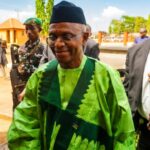

Leaders of the opposition African Democratic Congress have condemned the Independent National Electoral Commission over its derecognition of the party’s leadership.
Addressing a press conference on Thursday in Abuja, the National Chairman of the ADC, Senator David Mark, accused the commission of acting under the influence of the All Progressives Congress-led federal government.
He called for the immediate removal of the Chairman of INEC, Prof. Joash Amupitan.
“We demand the immediate resignation or sacking of the INEC Chairman, Professor Amupitan, and all the National Commissioners.
“We no longer have confidence in them. We are convinced that they are incapable of conducting any credible election,” Mark stated.
He maintained that the ADC under his leadership would continue its activities, insisting that there is no legal provision making INEC’s presence compulsory for party operations.
Mark said, “Since 1999, Nigeria has been under democratic rule. After 27 years, we thought we could proudly celebrate the entrenchment of democracy, believing that the country’s dictatorial past has receded into history. Our experience in the past three years or so has however confirmed otherwise.
“Democracy is only sustained by the quality of freedom that it offers and guarantees, especially the freedom to choose, the freedom to participate, and the freedom to associate. These freedoms are so critical to democracy that without them, democracy dies.
“Yet, in the past three years, we have witnessed a relentless assault on these very freedoms. The agenda is very clear, to create a situation where, in 2027, President Bola Tinubu emerges as the only option left for the people, despite the widespread suffering and wanton killings going on across the country.”
However, in a swift reaction, the electoral umpire dismissed the calls for Amupitan’s removal.
In a statement issued on Thursday night in Abuja and signed by the Chief Press Secretary to the INEC Chairman, Adedayo Oketola, the commission acknowledged the right of stakeholders to express their views, but stressed that its leadership and operations are constitutionally protected.
“It is imperative to clarify that INEC is a creation of the Constitution of the Federal Republic of Nigeria.
The appointment, tenure and removal of the Chairman and National Commissioners are strictly governed by Section 157 of the 1999 Constitution as amended.”
The commission had on Wednesday announced its decision to delist key ADC figures, including National Chairman David Mark, National Secretary Rauf Aregbesola and others.
The INEC National Commissioner and Chairman of the Information and Voter Education Committee, Mohammed Haruna, said the decision was in compliance with a court order directing the commission to maintain the status quo pending the determination of the case by the trial court.
The ADC has been enmeshed in a leadership crisis since July 2025, following Mark’s emergence as head of a new National Working Committee.
Disagreements over the role of former chairman Ralph Nwosu in the 2025 transition triggered internal opposition, which later escalated as rival factions laid claim to the party’s leadership, resulting in multiple court cases.
The development has created uncertainty within the party, raising concerns over its preparedness for the 2027 general elections.
Responding further, INEC emphasised the independence of its leadership, noting that “The chairman does not hold office at the pleasure of any political party or interest group.
“Any call for removal outside the established constitutional process is not only a distraction but a direct assault on the independence of the nation’s electoral umpire.”
Explaining its decision to comply with a recent Court of Appeal judgment, the commission said the move was necessary to avoid a recurrence of incidents recorded in Zamfara and Plateau States, where elected officials were removed by election tribunals due to disobedience of court orders.
According to the commission, it also acted in line with a preservative court order to avoid taking steps that could render proceedings before the Federal High Court nugatory.
INEC further stated that monitoring the activities of the David Mark-led faction of the ADC would amount to disobedience of the court order.
Clarifying the timeline of events, the commission noted that it was only on September 9, 2025, that it accepted and approved Mark’s executive, seven days after the matter had been filed at the Federal High Court.
It stressed that appellate court decisions are binding, adding, “Section 287(2) of the Constitution of Nigeria, 1999 mandates every person and authority in Nigeria not only to obey the Judgment of the Court of Appeal but also to enforce such Judgment.”
On allegations of undermining the multi-party system, INEC dismissed the claims, noting that the recent registration of new political parties, including the Democratic Leadership Alliance, the Nigeria Democratic Congress and the National Democratic Party, bringing the total number of active parties to 22, contradicts such assertions.
INEC maintained that it “remains a neutral regulator, not a participant in political competition.”
It also reiterated that it would not be drawn into internal disputes within political parties or serve as a proxy for resolving organisational conflicts.