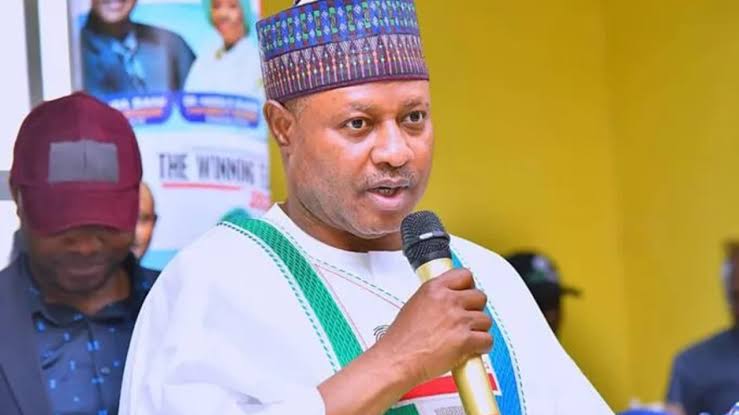






Kaduna state governor, Senator Uba Sani, has said that military and law enforcement strategies alone are not sufficient to curb the growing threat of violent extremism in Nigeria’s north-west.
The governor stated this on Tuesday in Kaduna while declaring opened a two day summit on Preventing and Countering Violent Extremism in North West zone.
Sani, who was represented by the commissioner for internal security and home affairs, Dr. Sule Shuaibu, described violent extremism as “one of the gravest threats to human security and national development in our time”.
He noted that “Its manifestations include terrorism, banditry, kidnappings, and the spread of extremist ideologies, which have inflicted pain on families, displaced communities, disrupted education, undermined livelihoods, and eroded trust in institutions”.
Sani stressed that, “If left unchecked, it has the potential to destabilize not only our region but also the broader fabric of our nation.”
While acknowledging the role of military intervention, the governor warned against relying on it as a standalone solution.
“We must, therefore, adopt a holistic and coordinated response. A purely military or law enforcement approach, while necessary, is not sufficient.
“We must address the structural and root causes of violent extremism – poverty, inequality, exclusion, poor governance, and lack of opportunities, particularly for our young people”, he said.
He called for “trust, inclusivity, justice, and respect for human rights” as key pillars of building community resilience against extremist ideologies.
He said the summit, themed, “Articulating a Regional Approach and Response to Violent Extremism in North West Nigeria”, was a chance to go beyond identifying problems, but crafting practical, context-specific solutions.
“It is my hope that our deliberations will go beyond diagnosis and lead to the articulation of concrete, context-specific, and sustainable strategies that can be implemented across the North West,” he said.
The governor also highlighted the importance of engaging communities, building institutional capacity, and promoting inclusive governance that addresses the needs of marginalized groups.
He said, “Kaduna state under my leadership remains fully committed to collaborative and innovative approaches to peace building.
“We are investing in human capital development, supporting community-based conflict resolution mechanisms, empowering women and youth, and working closely with traditional and faith leaders to counter divisive ideologies.”
He reaffirmed his administration’s commitment to working with the federal government, other north-western states, and international development partners to consolidate peace and security in the region.
Sani called on participants to engage constructively and with a spirit of collaboration so that the recommendations that emerge from meeting can serve as a blueprint for collective action.
Also in his address, the National Coordinator of the National Counter Terrorism Centre (NCTC), Maj.Gen. Adamu Laka said, preventing violent extremism in the north-west requires an inclusive, community-led, and intelligence driven regional response.
Laka, who was represented by Commodore Ahmed Madawaki, said the summit is a direct fulfilment of the NCTC’s mandate “of providing a platform for whole-of-government and whole-of-society engagement, fostering regional responses, and ensuring that preventive measures are rooted in inclusivity, resilience, and accountability.”
He added that, “Through collaborations with networks such as PAVE and other partners, we are implementing community-based initiatives that enhance social cohesion and provide sustainable livelihoods to reduce vulnerability to extremist recruitment.”
He noted that the security challenges facing the north-west are exacerbated by border proximity, weak governance, and environmental conflict.
According to him, “The Northwest faces specific challenges such as porous borders with Niger Republic, weak governance structures, climate-induced resource conflicts, and cross-border infiltration by extremist groups.”
He called for stronger enforcement, cross-border cooperation, and participatory governance models to address these threats.
Laka urged all stakeholders to play their part in a united front against terrorism.
Also speaking in an interview with journalists at the event, chairman of the steering committee of the Partnership Against Violent Extremism (PAVE), Jaiye Gaskiya said Nigeria will not overcome the threats of insecurity and violent extremism without empowering local governments and rebuilding community governance structures.
He emphasised the need for subnational governments to take ownership of security issues within their jurisdictions.
“We want to prioritise what roles subnational governments are expected to be playing because we cannot address the challenges directly as they are challenges of governance.”
Gaskiya argued that the fight against violent extremism will continue to falter if local governments remain weak and dependent.
“One of the things that we all need to do as citizens of Nigeria, is to understand that without effective Local Governments becoming very effective, functional and autonomous we are never going to be able to address these challenges,” he said.
According to him, local governments are the closest to the people and are the most accountable if they are functioning.
He called for constitutional reforms to restore the autonomy of local councils.
Sani: We must fix poverty, governance, to curb growing threat of violent extremism