


By Shu’aibu Usman Leman_
As Nigeria hurtles towards the keenly anticipated 2027 presidential elections, the political landscape is buzzing with seismic shifts.
At the heart of this unfolding drama is Peter Obi, a prominent figure whose audacious proposal for a single four-year presidential term is now firmly on the table. This bold initiative signals Obi’s unwavering commitment to integrity and transformative governance, potentially heralding a departure from the entrenched political practices that have long bedevilled the nation.
Obi, the former Governor of Anambra State, has consistently positioned himself as a leader dedicated to ethical governance and prudent resource management. His advocacy for a singular presidential term is presented as a radical measure aimed at cultivating a culture of accountability and tackling the pervasive issue of prolonged political tenures, often linked to corruption, inefficiency, and a lack of transparency.
He argues that a single, focused term would enable a President to dedicate their full attention to national development, unburdened by the distractions and pressures of re-election campaigns.
“Nigeria urgently requires leaders who are ready to tackle our numerous challenges head-on, unencumbered by the pursuit of re-election,” Obi declared during a recent public address. He posits that the drive for a second term frequently diverts resources, attention, and political capital away from effective governance. In theory, a single term could eliminate these distractions, facilitating an uninterrupted focus on implementing policies that promote national progress.
While Obi suggests that if given a chance to become President he will only govern for one term of four years, the feasibility of adopting a single-term presidency in Nigeria hinges on a complex constitutional amendment process.
The current constitution allows for two four-year terms. While a significant proportion of the Nigerian populace—around 84%, according to some surveys, including an Afrobarometer study—supports term limits and constitutional governance, the specifics of a single term present both advantages and disadvantages.
Presidential elections in Nigeria are notoriously expensive and often marred by political instability and violence.
For context, the Independent National Electoral Commission (INEC) budgeted approximately ₦305 billion for the 2023 general elections.
A single term could reduce the frequency of these high-stakes contests, potentially conserving public funds and alleviating societal tensions. Proponents argue that a president, unshackled from re-election concerns, could undertake bold, long-term decisions, even if initially unpopular, thereby fostering impactful reforms free from political pandering
Conversely, a primary criticism is that the prospect of re-election serves as a vital incentive for performance; without this motivation, a President may be less responsive to the electorate, knowing that their actions would incur no immediate electoral consequences.
Furthermore, four years might prove insufficient for enacting substantial transformative reforms in a nation as complex as Nigeria, particularly given bureaucratic hurdles and the time necessary for policies to mature and yield tangible results.
Implementing this proposal would necessitate significant political consensus, demanding a two-thirds majority in both chambers of the National Assembly and the approval of two-thirds of the State Houses of Assembly Achieving such widespread agreement for such a foundational change is likely to be arduous, as past attempts to amend presidential tenures have encountered notable resistance.
Central to Obi’s broader reform agenda is a powerful commitment to revitalising Nigeria’s beleaguered electricity sector.
For decades, erratic power supply has stifled economic growth, hindering industrial output and imposing considerable operational expenses on businesses and households alike. Obi firmly believes that a reliable and consistent electricity supply is vital for economic development. By decisively confronting this infrastructural deficit, he hopes to restore investor confidence and position Nigeria as an attractive market for both domestic and international capital.
“With consistent electricity, we have the capacity to overcome a multitude of challenges that currently hinder our growth, and ultimately, to re-establish Nigeria as a net exporting nation,” he asserted, presenting a vision that resonates across various economic sectors, from emerging small and medium-sized enterprises to large-scale industries.
Achieving this vision would require substantial investment in generation, transmission, and distribution infrastructure, alongside sweeping reforms of the regulatory framework and a robust crackdown on corruption within the power sector.
The formidable scale of this endeavour presents significant practical challenges, including securing adequate funding, ensuring technical expertise, and confronting entrenched interests.
Beyond policy, one cannot help but agree with Obi who has consistently argued that while it is impossible to achieve 100% result in governance but there can be 100% commitment.
It is instructive to note that Obi has garnered considerable public goodwill through extensive humanitarian efforts in northern Nigeria. His initiatives span critical areas such as education, healthcare, and poverty reduction, addressing urgent needs in underserved communities.
These efforts have not only enhanced his public reputation but have also been instrumental in developing a formidable grassroots network with the potential to exert considerable influence in the forthcoming electoral cycle.
His recent accolades from the Pantami community in Gombe, where he received significant honours, underscore his unwavering commitment to bridging the persistent ethnic and political divides that have historically fragmented Nigeria.
This increasing acceptance in regions where he previously faced electoral hurdles signals a broadening appeal—an essential factor for any successful presidential campaign in a country as diverse as Nigeria, home to an estimated 235 million people and over 370 ethnic groups. The capacity to transcend tribal and religious affiliations is crucial for fostering national unity and effective governance.
Adding another layer of intrigue to the political calculus is the recent formation of a formidable coalition among various political parties, with the express aim of unseating President Bola Ahmed Tinubu in the 2027 elections.
The African Democratic Congress (ADC) has officially joined forces, establishing this nascent coalition in Abuja, encompassing a diverse array of politicians from across the political spectrum.
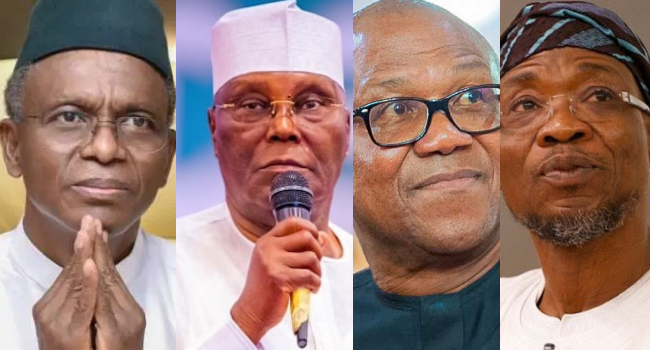
Prominent figures that attended the inaugural gathering included Alhaji Atiku Abubakar, former Vice President and the People’s Democratic Party’s presidential candidate in the 2023 election (who secured 6,984,520 votes or 29.07%); Mr. Peter Obi, the Labour Party’s presidential candidate in the same election (who secured 6,101,533 votes or 25.40%); Malam Nasiru El-Rufai, former Governor of Kaduna State; and Mr. Rotimi Amaechi, former Governor of Rivers State.
Additionally, the coalition featured other notable politicians such as Gabriel Suswan, former Governor of Benue State; Datti Baba Ahmed; Senator David Mark, former President of the Nigerian Senate; and Aminu Tambuwal, former Governor of Sokoto State, among others.
At the gathering, former Senate President David Mark was appointed as the Interim National Chairman of the ADC, while Rauf Aregbesola, former Governor of Osun State, was designated as the National Secretary.
In his remarks, Senator Mark emphasised that the coalition is not merely a power struggle but a vital step towards reshaping Nigeria’s democracy to facilitate more effective governance.
Mark extended an invitation to all Nigerian politicians willing to join the ADC in preparation for the forthcoming elections, urging members to remain dedicated and committed to the party’s advancement.
He highlighted the coalition’s operational focus, which aims to unite various opposition groups, political parties, youth organisations, and civil society across all regions of Nigeria. He stated, “Today marks the beginning of a long, arduous, yet essential journey towards uniting our collective vision and restoring Nigeria to greatness, irrespective of our diverse tribes, religions, and ethnicities.”
Following the event, Malam Nasiru El-Rufai criticised the ruling party for its perceived inadequacies in leadership, attributing the country’s current challenges to their governance. He expressed his belief in the ADC as a stable partner for this coalition, noting his continued affiliation with the Social Democratic Party (SDP) until after the forthcoming by-election in his state.
El-Rufai also announced plans to register a new political party with the Independent National Electoral Commission (INEC) to mitigate any political sabotage that might threaten the coalition. He described this new party as an alternative to avert challenges that have previously afflicted other political entities in the country. “Our aim is to reposition Nigeria’s democratic system and provide relief to citizens facing economic hardships. I am confident we can achieve this,” El-Rufai asserted.
The introduction of Obi’s single-term proposal to this newly formed coalition lays the groundwork for intricate new alliances and reconfigurations.
Ongoing discussions within political circles hint at a potential partnership between Obi and Atiku Abubakar, with speculation around a joint single-term ticket; Atiku is reportedly contemplating extending the Vice Presidential role to Obi. Such a strategic manoeuvre could significantly broaden the coalition’s appeal and garner widespread voter support by uniting diverse political bases.
This angle of argument may not actually materialise as Peter Obi has consistently maintained his desire to be on the ballot in 2027.
However, navigating the practicalities of such a coalition is complex, requiring considerable compromise on ideological differences and personal ambitions. While the notion of a single-term ticket may resonate with a populace fatigued by ongoing political strife, the intricacies of power-sharing and policy alignment within a diverse coalition are substantial challenges. History has shown that alliances, while enticing in theory, often grapple with internal dissent and issues of cohesion within Nigerian politics.
As Nigeria confronts a complex array of economic challenges, pervasive insecurity, and a collective public desire for substantive change, Obi’s initiative emerges as a beacon of hope for many citizens disillusioned by traditional political methods. His impassioned call for a novel leadership model resonates deeply across a nation yearning for a transformative agenda that prioritises robust economic revitalisation and enduring social cohesion.
“The challenges before us are undeniably significant; however, they are not insurmountable,” Obi stated during a recent public forum. “If we can unite, concentrate relentlessly on our shared national objectives, and commit wholeheartedly to integrity and transparency in governance, we possess the collective ability to build a Nigeria that truly works for every single one of its citizens.”
The implications of Obi’s bold single-term proposal are profound, suggesting a potential reconfiguration in how Nigerian politicians might approach governance and electoral strategy. As the 2027 elections draw near, the political dynamics of the nation are set for significant evolution, with keen anticipation surrounding the impact of this proposal on voter sentiment, its influence on political narratives, and its role in galvanising coalition-building efforts. While considerable challenges remain, Obi’s vision of a united, prosperous Nigeria continues to gain traction amid a populace increasingly weary of ineffective leadership and ongoing economic struggles.
The success of his proposition, along with his broader political aspirations, will rely not only on its theoretical appeal but also on the practical feasibility of its implementation and the ability to forge a broad-based consensus across Nigeria’s diverse political and social landscape.
Furthermore, Obi’s strong performance in the 2023 presidential election, where he notably gave both President Bola Ahmed Tinubu (who won with 8,794,726 votes or 36.61%) and Alhaji Atiku Abubakar a formidable run for their money, showcases his growing influence and readiness to challenge Nigeria’s political status quo as he seeks to galvanise support for his vision in the forthcoming elections.
Ultimately, the formation of this united front represents a pivotal moment for Nigeria.
Whether this new alliance can genuinely effect meaningful change, transcend the perennial squabbles of Nigerian politics, and present a cohesive vision for the nation remains to be seen.
The critical questions of who will emerge as their presidential nominee—be it Atiku Abubakar, Peter Obi, or another contender—and whether the delicate regional power-sharing considerations, particularly concerning the North and South’s turns at the presidency, will be honoured or disregarded, will define the trajectory of this ambitious political undertaking.
Only time will reveal if this coalition is indeed a beacon of hope or merely a source of further uncertainty for the future of Nigeria.
Leman is a former National Secretary of the Nigeria Union of Journalists (NUJ).
email: shuaibuusmanleman@yahoo.com